
| - |
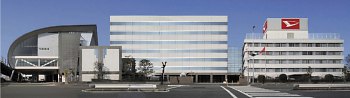
R&D center: Shiga
Main plants in Japan: Osaka, Shiga, Kyoto, Oita.
Main plants overseas: Malaysia (JV with Perodua), Indonesia (JV)
FY2017/18: 1,043,684 units
FY2016/17: 988,136 units
FY2015/16: 969,841 units
FY2014/15: 1,084,619 units
FY2013/14: 1,106,676 units
FY2012/13: 1,043,741 units
FY2011/12: 939,839 units
FY2010/11: 892,626 units
FY2009/10: 868,461 units
FY2008/09: 944,881 units
FY2007/08: 944,939 units
FY2006/07: 928,663 units
FY2005/06: 850,485 units
FY2004/05: 818,516 units
Global production (including Perodua and cars supplied to Toyota etc.):
FY2017/18: 1,676,836 units
FY2016/17: 1,578,461 units
FY2015/16: 1,414,027 units
FY2014/15: 1,589,541 units
FY2013/14: 1,696,330 units
FY2012/13: 1,528,937 units
FY2011/12: 1,435,000 units
FY2010/11: 1,303,000 units
FY2009/10: 1,315,000 units
FY2008/09: 1,401,000 units
FY2007/08: 1,392,000 units
Reference:
https://www.daihatsu.com/company/outline.html
https://www.daihatsu.com/news/index.html
In the 1950s, economic boom in Japan drove the demand of 4-wheel vehicles. While big manufacturers rushed to produce small passengers cars, Daihatsu remained concentrating on producing small commercial vehicles - vans, trucks or pickups, whatever - for small business runners used in the narrow streets of residential area. Its first 4-wheel truck was built in 1958, then followed by the popular mini pickup truck, Hijet, two years later. To cope with increased demand, Daihatsu expanded its Ikeda main plant.
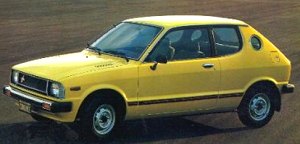 Charade (1977)
The 1963 Compagno commercial van introduced another breakthrough as it was derived into the company's first passenger sedan and sports car, i.e. Campagno Berlina and Spider, in the next two years. Expansion into passenger car market continued with the 1966 Fellow (its first K-car), the 1974 Charmant (first proper family car) and, how can we forget that, the 1977 Charade. The 1000cc-class Charade not only won Japanese Car of the Year award but also gave Daihatsu the first taste of success in export.
Under the guidance of government, Japan's motor industry underwent consolidation in the 1960s. Daihatsu and Hino went under the wing of Toyota by selling minority stakes to the latter. This meant Daihatsu could concentrate on making small cars without worrying of the competition from Toyota. With capital injection, Daihatsu built 3 more factories at Tada, Kyoto and Shiga in the early 1970s.
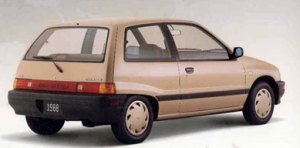 Charade Mk3 (1987)
In product side, more popular models were introduced in the following years - Mira / Cuore (1980), Rocky (1984, the first road-friendly small SUV), Charade Mk3 (1987), Move (1995, tall-body K-car MPV) and Terios (1997, mini SUV). They enabled Daihatsu to challenge Suzuki for the number 1 spot in domestic small car market. However, Daihatsu failed to expand its success beyond small cars. Its 1500cc-class Applause and Gran Move failed to impress people.
Export also became increasingly difficult as the Mk4 Charade did not repeat the magic of its predecessor. Daihatsu lost ground to Suzuki in Europe as it refused to build a factory there. In the United States, it never made a mark because its best cars were considered to be too small for the taste of American, while its biggest cars were unappealing. Its fortune depended increasingly more on its home market and its joint-ventures in Southeast Asia, such as Perodua of Malaysia.
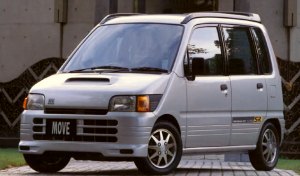 Move (1995)
In 1998, Toyota increased its stakes in Daihatsu from 34.5% to 51.2%. With closer relationship, the two companies started developing joint projects, e.g. Daihatsu Boon / Toyota Passo and Daihatsu Coo / Toyota bB. In 2016, Toyota acquired the remaining stakes and completely controlled Daihatsu.