
| FAW
Volkswagen - 60% |
| FAW Toyota - 50% |
| FAW Mazda
- 75% |
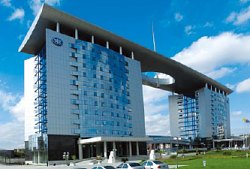
Main assembly plants: Changchun (FAW, Mazda), Changchun (JV with VW), Tianjin (JV with Toyota), Hainan (Haima).
2016: 3,105,700 units
2015: 2,843,900 units
2014: 3,086,100 units
2013: 2,908,400 units
2012: 2,645,900 units
2011: 2,601,351 units
2010: 2,558,166 units
2009: 1,945,000 units
2008: 1,533,000 units
2007: 1,435,982 units
2006: 1,165,702 units
2005: 1,047,000 units
2004: 1,007,000 units
2003: 902,000 units
2016 sales by division/subsidiary:
FAW Volkswagen: 1,854,000 units
FAW Toyota: 658,800 units
FAW Mazda: 92,000 units
FAW Passenger Car: 193,500 units
FAW Jiefang: 214,000 units (trucks)
FAW Jilin: 74,000 units (mini cars)
2016 domestic sales by model:
Volkswagen Jetta: 348,437 units
Volkswagen Bora: 222,279 units
Volkswagen Golf: 215,225 units
Volkswagen Sagitar: 341,331 units
Volkswagen Magotan (Passat): 171,283 units
Volkswagen CC: 29,148 units
Audi A3: 84,784 units
Audi A4L: 97,421 units
Audi A6L: 135,730 units
Audi Q3: 88,901 units
Audi Q5: 129,453 units
Toyota Vios: 117,041 units
Toyota Corolla: 307,360 units
Toyota Reiz (Mark X): 16,875 units
Toyota Crown: 30,251 units
Toyota Rav4: 116,389 units
Toyota Prado: 37,090 units
Mazda 6 (Mk1+Mk2+Mk3): 42,520 units
Mazda CX-4: 37,719 units
Mazda CX-4: 2,405 units
Haima M3: 31,482 units
Haima M6: 11,040 units
Haima S5: 65,226 units
Besturn B30: 39,515 units
Besturn B50: 33,895 units
Besturn B70: 4,599 units
Besturn B90: 358 units
Besturn X80: 19,775 units
Reference:
http://www.faw.com/
http://www.faw.com.cn/index.jsp
http://www.qqbenz.com/
http://www.qichexl.com/a/xiaoliangpaixing/
FAW operates 5 brands in China: Xiali, Haima, FAW, Hongqi and Jiefang. The first four are used to sell sub-compact cars, compact cars, middle-class cars and luxury cars respectively, while Jiefang is a truck brand.
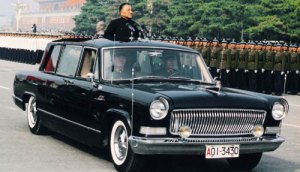 Hongqi limousine taking Deng Xiaoping
(1984)
Hongqi limousine taking Deng Xiaoping
(1984)The first FAW product was a truck named "Jiefang", which meant "Liberation" in typical communist style. In the first three decades, FAW was essentially a truck manufacturer, although it also produced a handful of Hongqi (or "Red Flag") luxury limousines for party leaders based on outdated Soviet designs. Ironically, millions of Chinese people died in hunger in the late 1950s, then waves of political thunderstorms killed similar amount in the next two decades. China had been famous for poverty, thus mass production of passenger cars was out of question.
In 1978, Deng Xiaoping launched an economic reform whose alternative name was "capitalism". As a result, the state-owned FAW became profit and market-oriented. It sent engineers to Japan for training and modernized its production plant. Production of trucks increased following domestic economic growth. The 1 millionth Jiefang truck was built in 1983.
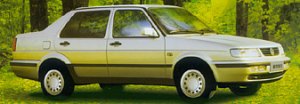 Jetta Mk2 (1991-)
Mass production of passenger cars finally commenced in 1989, when FAW established a joint-venture with Volkswagen to produce cars in China. Initially, the venture assembled old Audi 100 based on knock-down kits, then it started producing the equally outdated Volkswagen Jetta Mk2 (which is still in service today). These cars were extensively used as government cars and taxis all over China.
2002 saw FAW acquired local competitor Tianjin Auto, which brought it the Xiali small car brand and relationship with Toyota. Later on, FAW formed another joint-venture with Toyota to produce its cars in China. Thanks to these foreign ventures, FAW became the first Chinese car maker to reach 1 million units of annual sales in 2004.
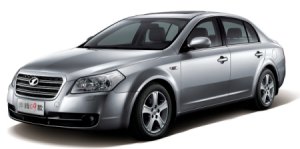 Besturn (2008)
In the late 2000s, the company tried to increase the local content of its cars. With help from Western engineering consultants and design houses, it developed its own designs like Vita C1, Haima 3 and Besturn. However, their underpinnings were still based on its existing joint-venture cars. Despite of its existence for over half a century, FAW has yet to realize the original target of Mao Zedong.