 We
used to call the previous W140 as the best car in the world. (In then,
it was not yet called "S-class") However, in terms of profitability it
was never that successful. Ruled by the engineer's heart rather than
accountant's
brain, development cost resulted in double of the original budget to 1
billion pounds, making the W140 project inherently a loss. Sales no.
also
reflect the unsuccessful story of the W140, partly because of high
price,
partly because of its heavy weight, environmental unfriendly
image. We
used to call the previous W140 as the best car in the world. (In then,
it was not yet called "S-class") However, in terms of profitability it
was never that successful. Ruled by the engineer's heart rather than
accountant's
brain, development cost resulted in double of the original budget to 1
billion pounds, making the W140 project inherently a loss. Sales no.
also
reflect the unsuccessful story of the W140, partly because of high
price,
partly because of its heavy weight, environmental unfriendly
image.
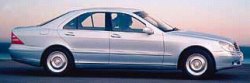
Having learned from this lesson, Mercedes created a very different car, W220, to substitute the W140. The first to be changed is the size of the car. Having seen the success of Lexus's LS400, which outsold all Germany luxurious sedans in the US, Mercedes made the new S-class to be much smaller than its predecessor and runs much closer to the mainstream rivals. Length / width / height have been reduced by 55 / 31 / 41mm. Furthermore, via using high strength steel, all-alloy engines and discarding the double glazing in the windows, the Foreman becomes Holyfield. Long wheelbase version of S500, for example, weighs 1855kg instead of the previous 2150kg, this means a reduction of 300 kg ! For comparison, Lexus LS400 weighs 1830kg, while BMW 750il weighs 2140kg. And of course, Holyfield is more nimble, eat less and win matches more comfortably.
Many magazines praised the technology used in the W220, however, I'm not completely agree with them. There are really many "electronic" blah blah blah, but most of them are not new items nor significant technology breakthrough. For examples:
 The
engines are the
"3-valves"
series already used in C-class and E-class. As said a thousand times,
they
shifted back to 3-valves configuration in order to pass the Euro2004
emission
regulations. Smaller surface area of the single exhaust manifold
quicken
engine warm up thus reduce cool start pollutant. 90 degree V-angle was
chosen to optimize the V8, thus the 3.2 litres V6 is added with
balancer
shafts. Variable-length induction manifold and variable valve timing
are
adopted to ensure the torque spread uniformally over a wide range of
rpm. The
engines are the
"3-valves"
series already used in C-class and E-class. As said a thousand times,
they
shifted back to 3-valves configuration in order to pass the Euro2004
emission
regulations. Smaller surface area of the single exhaust manifold
quicken
engine warm up thus reduce cool start pollutant. 90 degree V-angle was
chosen to optimize the V8, thus the 3.2 litres V6 is added with
balancer
shafts. Variable-length induction manifold and variable valve timing
are
adopted to ensure the torque spread uniformally over a wide range of
rpm.
Due to the improved torque curve and reduced weight, all models become faster and more frugal. The S500 has been tested to take just 6.2 sec for completing 0-60mph, 15.1sec to 0-100mph. This is the fastest ever achieved by this class of cars. Who need those V12 monsters ? Rack and pinion steering replaces the long-serving recirculating ball. The result is improved steering feel and reduced cost. S-class still handles less good than the 7-Series. Not just in terms of steering but also in body control. But the gap is narrower than ever. What it overshadow rivals are the effortless performance married with the supple ride from the adaptive air suspensions, the smooth and quite engines and the class-leading built and comfort.
Undoubtedly, the
S-class
is again the best car in the world. |
| The above report was last updated in 1998. All Rights Reserved. |
 Gone
is the concert hall-like cabin. The tilter windscreen and rear window
make
occupants subjectively feel their head room more restricted. In fact,
those
room was too BIG in the past and was never very useful. Similarly, the
width of the old car was excessive. Occupants other than dressed-up
American
Footballers never need so much shoulder room. On the contrary, it just
made your passenger felt lonely. The new car just reduces those useless
space to achieve size and weight reduction. There are more
sub-products,
for examples, tilter windscreen and rear window contribute to the
remarkable
0.27 drag coefficient (equals E240 and Lexus LS400), smaller dimensions
contributes to the 40% increase of chassis rigidity thus benefit
handling
and ride, at last, a sleeker exterior styling can be implemented.
Gone
is the concert hall-like cabin. The tilter windscreen and rear window
make
occupants subjectively feel their head room more restricted. In fact,
those
room was too BIG in the past and was never very useful. Similarly, the
width of the old car was excessive. Occupants other than dressed-up
American
Footballers never need so much shoulder room. On the contrary, it just
made your passenger felt lonely. The new car just reduces those useless
space to achieve size and weight reduction. There are more
sub-products,
for examples, tilter windscreen and rear window contribute to the
remarkable
0.27 drag coefficient (equals E240 and Lexus LS400), smaller dimensions
contributes to the 40% increase of chassis rigidity thus benefit
handling
and ride, at last, a sleeker exterior styling can be implemented.
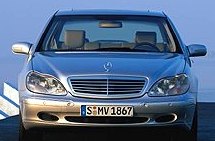 Spacious
cabin
(compare with
rivals instead of the W140) aside, you can hardly complain with the
seats
and the equipments. You might have seen a massager-incorporated seat in
Infiniti, what about an electrically cooling plus ventilating seat ? 10
electic fan was hidden inside the back rest and cushion, operate to
reduce
perspiration. The massager is implemented by the inflation and
deflation
of air cushions. Build quality and trimming material is first class,
making
the Lexus looks boring. Like several new cars we've already seen, say,
Alfa 166 and Audi A8, the navigation screen also integrates audio
control,
TV, voice-phone and trip computer. It looks as sophisticated as the car
itself.
Spacious
cabin
(compare with
rivals instead of the W140) aside, you can hardly complain with the
seats
and the equipments. You might have seen a massager-incorporated seat in
Infiniti, what about an electrically cooling plus ventilating seat ? 10
electic fan was hidden inside the back rest and cushion, operate to
reduce
perspiration. The massager is implemented by the inflation and
deflation
of air cushions. Build quality and trimming material is first class,
making
the Lexus looks boring. Like several new cars we've already seen, say,
Alfa 166 and Audi A8, the navigation screen also integrates audio
control,
TV, voice-phone and trip computer. It looks as sophisticated as the car
itself.