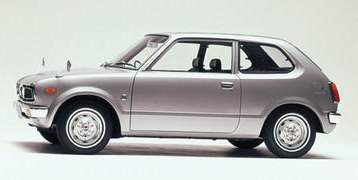
Civic Mk1 (1972-79)
The S500 series took Honda
from
a motorcycle maker to a sports car maker, but the ultimate goal of
Soichiro Honda was to be a volume car maker like Nissan or Toyota. His
dream finally came true in 1972 when he launched a mass production
small car called Civic.
Viewing it today,
the original Civic was neither beautiful nor
innovative. However, thanks to the engineering-led approach of Soichiro
Honda, it followed closely the latest development trend in Europe, more
so than any other Japanese car makers. In 1971, Fiat introduced the
trend-setting FF layout with transversely-mounted engine and
all-independent suspensions to its 127 mini car. Just one year later,
Honda Civic arrived with the same features. That was the same year as
Alfa Romeo's Alfasud and 2 years earlier than Volkswagen Golf ! Of
course, most other European car makers were still using rear-drive for
their small cars, so you can see how advanced the Japanese new comer
was. The FF layout gave Civic a relatively roomy cabin out of the 3.4
meters length, while the all-round strut-type independent suspensions
gave it good ride quality. Besides, by using thinner gauge steel to
construct its monocoque, it was lightweight, fuel efficient and cheap
to build. A third place at the 1974 European COTY award proved how
impressive it was in the eyes of European jurors.
The original Civic
was also famous for state-of-the-art engines. Well,
maybe not as outstanding as Alfasud's boxer engine, but for such a
small and cheap car a 1.2-liter SOHC all-aluminum four-pot engine was
the best people could dream of. Honda's expertise in motorcycle engines
and racing engines guaranteed it produced a class-leading 60 hp even in
the basic form, or 76 hp in the RS form. Therefore the Civic provided
good performance for money.
Another milestone
was laid in 1973 when the Civic introduced a
1.5-liter CVCC engine. CVCC stands for Compound Vortex Controlled
Combustion. It added a pre-combustion chamber to each cylinder. Fuel
was burnt in the pre-combustion chamber first and then spread to the
main combustion chamber. This approach allowed leaner air/fuel mixture
than conventional engines thus more complete combustion. As a result,
the CVCC Civic was the only car meeting the stringent requirements of
1975 US Federal emission regulations without resorting to catalytic
converters (hence a cost advantage over competitors). Moreover, it was
rated by EPA as the most frugal car in the USA.
Thanks to the 1973
Energy Crisis, the fuel-efficient Civic became an
immediate hit in the US market. It opened the gate for volume export to
the America and lifted Honda to be a volume car maker.
Evolution
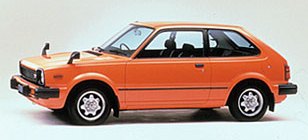
Mk2 (1979-83)
|
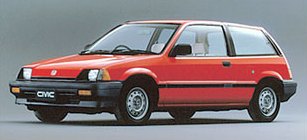
Mk3 (1983-87) |
|
|
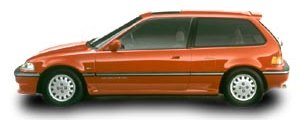
Mk4 (1987-91)
|
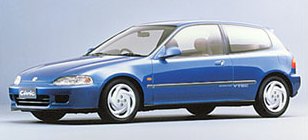
Mk5 (1991-95)
|
|
|
Mk5 sedan (1991-95) |
Mk5 sedan (1991-95) |
|
|
Mk6 sedan (1995-2000)
|
Mk6 hatch (1995-2000)
|
|
|
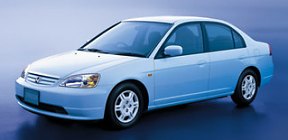
Mk7 sedan (2000-05)
|
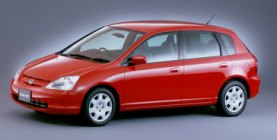
Mk7 5-door hatch (2000-05)
|
|
|
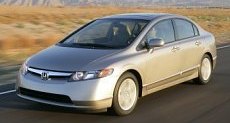
Mk8 sedan (2006-11) |
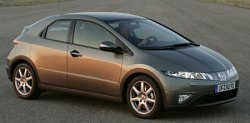
Mk8 hatch (2006-11) |
The original Civic was
finally
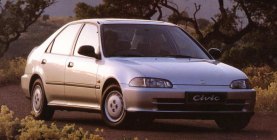
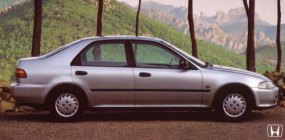
replaced in 1979 by the second generation, then the third generation in
1983, fourth generation in 1987, fifth generation in 1991... The speed
of development shocked Western car makers. Compare with contemporary
European rivals, Civic usually looked more modern and equipped with
sophisticated technology unavailable to its rivals. For example, the
3rd generation Civic put 3-valve-per-cylinder engines into mass
production, a first for the industry. The 4th generation upgraded to 4
valves per cylinder, again earlier than everybody else. The 5th
generation made VTEC (variable valve timing and lift control) standard.
Honda used advanced engines, all-round double-wishbone suspensions and
sporty styling by means of low seating position and a sloping bonnet
(which was made possible by leaning the engine forward) to create a
sporty image for the car, although it didn't really handle as well as
the best European hatchbacks. Anyway, it successfully lured younger
customers from Toyota and Nissan.
In my opinion, the
golden years of Civic ran from the third to the
fifth generation, as each of them brought a surprising level of
progress no matter in performance, styling or build quality. After
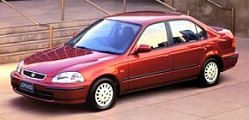
that, the Civic suddenly went conservative in the 6th generation
(1995-2000). The 7th generation (2000-05) attempted to diversify itself
to suit different markets, but it still failed to capture the forward
thinking spirit of the 3rd to 5th generation. The 8th generation
(2006-11) might look more radical, but underneath the skin was actually
an average machine.
Through
the years Civic was never lack of fast versions. However, the hottest
of which was undoubtedly Type R. Honda introduced the "Type R" label
for the first time in 1995 on Integra. Instead of the usual performance
enhancement, the Type R represented a really hardcore conversion
ranging from stripped-out cabin, hand-built engines to the use of many
expensive components. Therefore the Type R was produced in limited
numbers and reserved for the domestic market.
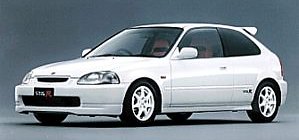
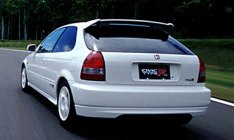
First generation - EK9
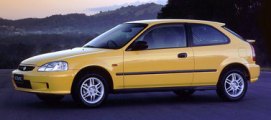
In 1997, Civic also received the Type R treatment. Based on
the 6th
generation Civic's EK9 3-door hatchback body, it was commonly referred
to EK9 Type R. Its B16B 1.6-liter DOHC VTEC engine got aggressive
tuning including higher compression ratio, lightweight forged pistons,
hand polished intake ports and more aggressive VTEC setting. This
raised its red line to an astonishing 9000 rpm, maximum power from 170
hp to 185 hp at 8200 rpm. That was some 116 horsepower per liter ! At
the time it was the world's most efficient naturally aspirated engine.
On the downside, the small engine capacity limited its max torque to
118 lb-ft and it was delivered in a peaky manner. To compensate for the
lack of low down torque, Honda fitted a close-ratio gearbox and ordered
its chassis to undergo a strict diet. The result was the deletion of
air conditioning, power steering, sound deadening and ABS. Besides, the
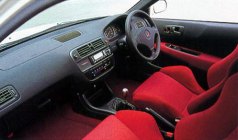
regular seats were replaced by lightweight Recaro buckets, accompanied
with serious-looking Momo steering wheel and titanium gear knob. As a
result, the Civic Type R weighed only 1040 kilograms. Use its
high-revving power smartly, it could accelerate from 0-60 mph in six
point something seconds and flat out at near 140 mph.
The chassis of Type
R was reinforced by using seam welding and
suspension tower brace front and rear. Of course, the double-wishbone
suspensions were stiffened a lot to enable flat cornering, while
Bridgestone Potenza RE010 tyres provided extra grip. A helical LSD
(limited slip differential) was added between the front wheels to
ensure no wheelspin during hard cornering. The first generation Civic
Type R was a hardcore driver's car, more so than any hot hatches at the
time I could think of.
Second generation - EP3
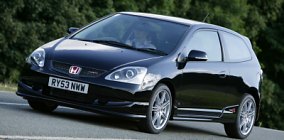
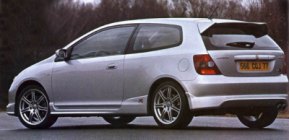
The second generation Civic Type R was derived from the EP3
body of the
7th generation Civic. Surprisingly, it was produced exclusively in the
Swindon plant in UK because Honda no longer produced Civic hatchbacks
at its home country. Also changed was its market positioning - no more
exclusive hardcore driver's car, now it wanted to sell large quantity
in the European market. That means it had to sacrifice the expensive
limited slip differential and Recaro seats. The chassis was much the
same as the standard car except riding on 15 mm lower ride height and
reinforced by tower bars. The engine was no longer hand-built, but a
detuned version of the contemporary Integra Type R's unit. To make it
easier to live with, its cabin had all the creature comfort of the
regular car, while the suspensions were set to be far more absorbent
than the first generation Type R. Now the whole car weighed some 1200
kg.
Nevertheless, the
EP3 Type R was still quicker than EK9 in real world,
thanks to a larger K20A 2.0-liter DOHC i-VTEC engine. The K20A might
had lost human intensive treatment, but its 400 cc extra capacity and
the adoption of new i-VTEC system, which added continuous variable
intake cam phasing to the existing cam-switching VTEC mechanism, pushed
maximum output to 200 horsepower at 7400 rpm. The engine was not as
high-revving as before, but it produced far superior mid-range torque -
from 3000 rpm upward there was at least 90 percent of the maximum 145
lb-ft available. In addition to the new 6-speed close-ratio gearbox,
the new Type R could top 146 mph and did 0-60 mph in 6.7 seconds.
Although hardcore
drivers never adored the EP3 like its predecessor,
its wonderful engine, strong performance, slick gearchange, accessible
handling and roomy cabin won high acclaims from the British press. It
was also once the class leader in AutoZine's hot hatch rating. Its
biggest weakness was a numb steering, blame to the use of electric
assistance. Some people disliked its tall and fat appearance, but with
the Type R cosmetic enhancement it actually looked prettier than the
EK9.
Third generation - FD2 and FN2
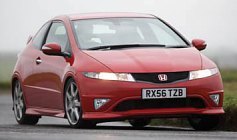
 FN2: European Type R hatchback
The third generation Type R followed the regular Civic Mk8
to provide 2 different versions. FN2 was derived from the European
Civic hatchback and again it was assembled at the Swindon plant. While
its exterior and interior design looked radical, its mechanicals were
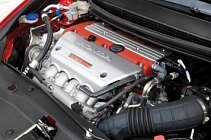
less so. The engine was again that high-revving K20 2.0-liter i-VTEC,
tuned to deliver a slightly flatter torque curve, a smoother but less
exciting VTEC switchover and better refinement by the addition of
balance shafts. However, its maximum power remained much the same at
201 hp, whereas kerb weight was up by 67 kg, so its performance was
unchanged and now overwhelmed by many turbocharged European rivals. The
hatchback's downgrade to torsion-beam rear suspension hurt body control
on bumpy roads, although ride refinement was actually improved from the
old car. A quicker ratio steering, wider tracks, larger brakes and
fatter tires clawed back some marks, but not enough to put it back to
the top of the class.
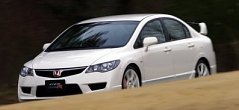
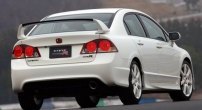 FD2: Japanese Type R sedan
Interestingly, the FD2 Type R based on Japanese/American
Civic sedan
might look more civilized but it was actually the more hardcore choice.
Its Japanese spec. engine was more highly tuned, running 11.7:1
compression instead of the hatchback's 11.0:1, plus larger diameter
throttle body and higher flowing intake and exhaust manifolds to
deliver 225 hp (JIS) at 8000 rpm, giving it an edge in straight line
performance over the hatchback.
Although the sedan
body was larger, it was also stiffer than the
hatchback. It weighed the same too, thanks to a striped-out interior.
Besides, it got stiffer springs and dampers, lower ride height, larger
Brembo brakes, a standard Torsen LSD and a large rear spoiler. The
multi-link rear suspension delivered superior control over the
semi-independent stuff on the hatchback. The handling was sharp and
precise like a track car, as was the rock-hard ride. The hydraulic
steering offered more direct feel than the usual electrical power
steering. All in all, it was a superb hardcore driver's car like the
original EK9.