|
|
|
Published
in 1998
|
All rights reserved.
|
|
 Launched
in 1957, Seven was the first road-going Lotus. Although Lotus has
officially
ceased its production in 1973, the production right was succeeded by
Caterham
and it is still in production now and even at a rate of 1,000 per year.
If you do not count the Brazilian built Beetle, Seven would be the
oldest
car you can buy. Launched
in 1957, Seven was the first road-going Lotus. Although Lotus has
officially
ceased its production in 1973, the production right was succeeded by
Caterham
and it is still in production now and even at a rate of 1,000 per year.
If you do not count the Brazilian built Beetle, Seven would be the
oldest
car you can buy.
In
those days,
its tubular
steel spaceframe chassis was an advanced design, just like the
aluminium
chassis of Elise in today. As it is as light as 575kg, the Rover
K-series
engines can push the car from zero to 60mph in just 6sec. Top speed is
let down by the poor aerodynamics, since its creator Colin Chapman was
more concerned the acceleration and cornering stability.
Seven
is a
minimalist. It
got no radio, no air-con, no glove box, no door and no roof. But the
advantage
is the optimal weight saving, which transfer to the super steering
response
and adjustability in corner. No car could provide more pure driving fun.
|
Verdict: not
rated
|
Published
in 1998
|
All rights reserved.
|
|
7 Superlight R500
|
Imagine a
car with
190hp, weighing
at only 470kg, no roof, no windscreen, no equipment, exposed
wheels....you
might have been thinking a Formula 3 racing car, no, it is a road car,
Caterham Superlight R.
Superlight
R is
almost a
racing car, in fact, its theory is every bit the same as racing car.
Power
comes from the race-tuned Rover 1.8 litres K series 16 valves, with
190hp
at nearly 8,000 rpm and 150lbft peak torque. This engine is so racy
that
it can't pass emission and noise regulations, so import to US is
infeasible.
In Europe, people can buy this car in kits form to avoid violating the
law.
All
panels are
aluminium,
without glass and soft roof so that the kerb weight is reduced to
record
low. This further improve the already excellent handling of the car,
while
0-60 is also benefited - my estimation is 4 seconds flat.
Recently,
Autocar
magazine
performed a test in Nurburgring track with this car against Porsche new
911 Carrera (300hp), Ruf 911 CTR2 (520hp) and Nissan Skyline GTR
(280hp,
4wd, 4ws), the lap time is amazingly found as follows:
- Caterham
Superlight R ..........
8 min 6.2 sec
- Ruf
911 CTR2
.......................
8 min 15.0 sec
- Nissan
Skyline
GTR ..............
8 min 28.1 sec
- Porsche
911
Carrera .............
8 min 38.4 sec
Benefited by
the
light weight
and superbly balanced chassis, the Superlight R ran considerably faster
than others in bends, although it lost a lot of time in fighting with
drag
in straights. Road tester found it handles very much better than
others,
it is virtually a racing car.
Nurburgring
is
usually regarded
as the best place to test a car's real world performance - it has high
speed straights as well as a hundred bends with different speeds. The
Superlight
R broke the track record for non-modified road car, so, maybe we can
call
it "the fastest car in the world". Hard to accept ? Ferrari F50,
McLaren
F1, Nismo Skyline 400R and Porsche 911 GT1 (this is really a racing
car!)
might be faster, but until they are tested in Nurburgring, the Caterham
still remains to be the King. |
Verdict: not
rated
|
Published
on 29
Nov 1999
|
All rights reserved.
|
|
7 Superlight R500
|
 Pressurized
by arch-rival Westfield’s FW400, Caterham has upgraded its racy Seven
Superlight
R into the R500, the name implies 500 horsepower per ton. Weighing in
460kg,
the R500 is 10kg lighter than its predecessor but still yet to match
the
400kg of the FW400, which has full-carbon fiber chassis instead of
Caterham’s
traditional tubular space frame. However, modifications to the VHPD
engine
squeezed another 40hp, that makes a total of 230hp. No wonder in terms
of power to weight ratio the Caterham beats the Westfield. Pressurized
by arch-rival Westfield’s FW400, Caterham has upgraded its racy Seven
Superlight
R into the R500, the name implies 500 horsepower per ton. Weighing in
460kg,
the R500 is 10kg lighter than its predecessor but still yet to match
the
400kg of the FW400, which has full-carbon fiber chassis instead of
Caterham’s
traditional tubular space frame. However, modifications to the VHPD
engine
squeezed another 40hp, that makes a total of 230hp. No wonder in terms
of power to weight ratio the Caterham beats the Westfield.
Weight
saving
is
by means
of lighter material used. In this aspect, magnesium is the best
material
to replace aluminium in engine sump and wheel hubs; Apart from the nose
cone and wings, carbon fibre now spreads to the wind deflector (which
is
used instead of windscreen to further reduce weight), rear view
mirrors,
sill protectors, dashboard and bucket seats. The instrument reading is
implemented by digital LCD like racing cars.
Then
comes the
power. The
190hp VHPD is already a Very High Performance Derivative of the Rover
K-series
(as its name implies). The 1.8-litre unit is now further enhanced by
forged
steel crankshaft and con-rods, Cosworth-made lightweight forged
pistons,
larger ports, higher lift camshafts and a touring-car-styled roller
barrel
throttle instead of conventional butterfly throttle. The roller barrel
reduces pumping loss by its lack of air resistance. As a result, it
pumps
out 230hp at 8,600rpm and 155 lbft at 7,200rpm. Given sufficient
run-in,
it can spin to the 9,200rpm red line ! even more revvy and more
efficient
than Honda’s mighty S2000. Admittedly, the Caterham complies with
looser
emission requirements because it falls into the low-volume type
approval
scheme.
It is a
surprise
to find
that the R500’s engine is more tractable than the Superlight R. Not
just
Caterham’s boss said so but journalists also found so. At low speed it
is not as difficult to drive as the R. At high speed it displays
superior
performance. Caterham sees this car as a true successor to the Seven
JPE
of 1992. If you don’t remember, you are reminded that the mighty JPE
was
powered by a 250hp engine derived from Opel’s 2-litre 16V, weighed
540kg
and still holds the British 0-100mph-0 record of 12.41 seconds. To
challenge
the JPE’s record, a perfect launch is require, so Caterham has given
the
R500 a traction control. Without the electronics, you had better to up
shift with a lightening action, otherwise wheelspin will spoil the
chance.
Although
claimed
to be capable
of taking just 3.4 sec to 60mph, the roofless machine is primarily
designed
to eat bends on race tracks, so are its radial tyres. Extra care must
be
taken to prevent over press the throttle in low gear corners, as the
surge
of power will induce oversteer. Always remember it is a 500hp/ton
supercar.
In
late '99, it
set a new
lap record of Nurburgring in 7 min 55.21 sec, marginally faster than
the
previous record holder Porsche 911GT3. |
Verdict: not
rated
|
Published
on 10
May 2005
|
All rights reserved.
|
|
7 CSR
|
 It
has been more than 5 years since I last wrote about Caterham Seven, but
compare with the 48 years history of the car, this is nothing.
Unbelievably, almost half a century after Colin Chapman put the Seven
into production, the car received its first thorough redesign. It
has been more than 5 years since I last wrote about Caterham Seven, but
compare with the 48 years history of the car, this is nothing.
Unbelievably, almost half a century after Colin Chapman put the Seven
into production, the car received its first thorough redesign.
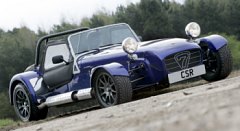
Externally, the
Seven
CSR260
still looks like a classic Seven, but underneath the skin is a new
story. Its tubular spaceframe chassis is derived from the previous
wider body SV (which provides more room than traditional Seven), with
25% increase of torsional rigidity. All suspensions are new – the
long-serving non-independent de-Dion rear axle is finally replaced with
modern double-wishbone. It gives far better wheel control and ride
quality, lifting both handling and ride. The front suspensions are also
converted to double-wishbone, whose springs and dampers are moved to
inboard, operated by pushrods, in order to improve aerodynamics.
You may notice the
wheels
are
now much bigger and wider, almost like Formula 3 wheels. They grow by 2
inches in diameter to 15 inches, and wear 255/40 tires at the rear,
compare to the 215/50 tires used in the previous Seven R500. These are
half-slick tires developed specially by Avon.
 In the past decade the
Seven was powered by Rover K-series engines. In the previous R500 Evo, the hottest
K-series engine was so highly tuned that it could produce 250
horsepower from 2.0 litres of displacement. The downside was lack of
mid-range torque and reliability. Because of this, Caterham turned to
engine expert Cosworth for a new engine. (Coincidence or not, this also
saved Caterham when MG Rover bankrupted.) In the past decade the
Seven was powered by Rover K-series engines. In the previous R500 Evo, the hottest
K-series engine was so highly tuned that it could produce 250
horsepower from 2.0 litres of displacement. The downside was lack of
mid-range torque and reliability. Because of this, Caterham turned to
engine expert Cosworth for a new engine. (Coincidence or not, this also
saved Caterham when MG Rover bankrupted.)
Unbelievably, the
Cosworth
2.3-litre 16V engine was developed based on a Ford commercial van
engine. However, virtually everything has been changed. It has bespoke
cylinder head, intake manifolds and exhaust, valves, camshafts,
pistons, forged connecting rods, aluminum block, dry sump
lubrication...
 There are two stages of
tune for the engine. The cheaper CSR200 produces 200 horsepower at 7000
rpm and 165 lbft at 5750 rpm. The hotter CSR260 has lightweight forged
pistons and racing-style roller barrel throttle (which reduces air
resistance) to produce 260 horsepower at 7500 rpm and 200 lbft of
torque at 6200 rpm. Caterham says the CSR260 can sprint to 60 mph in
3.1 second, beating a McLaren F1. Its 155 mph top speed also sets new
standard for the Seven. There are two stages of
tune for the engine. The cheaper CSR200 produces 200 horsepower at 7000
rpm and 165 lbft at 5750 rpm. The hotter CSR260 has lightweight forged
pistons and racing-style roller barrel throttle (which reduces air
resistance) to produce 260 horsepower at 7500 rpm and 200 lbft of
torque at 6200 rpm. Caterham says the CSR260 can sprint to 60 mph in
3.1 second, beating a McLaren F1. Its 155 mph top speed also sets new
standard for the Seven.
On the road, the first
thing you notice is
how much more supple the CSR ride. Thanks to the extensive tuning work
spent by Caterham, they found a perfect damping setting – on B-roads it
rides even better than Lotus Elise. The independent double-wishbone
suspensions have much longer travel and therefore absorb bumps with
ease. They also keep the tires perpendicular to the road regardless of
bumps, thus generate more grip and predictable handling at all
conditions.
The CSR is 100kg
heavier
than
R500 Evo, but at 570 kg it is still 300 kg lighter than a Lotus Elise
111R. No wonder it steers, accelerates and stops with incomparable
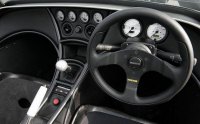
responsiveness. The tiny steering wheel transmits streams of
information in the same way as racing cars. This is not only the
fastest, but also the best handling and best riding Caterham
Seven ever produced. The only thing you have to consider is price: a
factory built CSR260 costs £36,500. That almost matches a Porsche
Boxster S. |
Verdict: not
rated
|
Published
on 17
May 2008
|
All rights reserved.
|
|
7 Superlight R500 (2008)
|
|
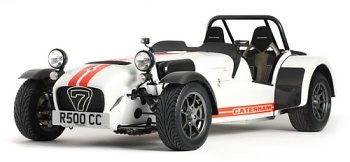
New R500 has many things mirroring the
old one, including its ability to thrill its drivers...
|
9
years ago Caterham produced the famous Superlight R500, a Seven with a
power-to-weight ratio of 500hp per ton. It could beat any supercars of
its days in racing tracks, no kidding. Time seems frozen for the
following
years. Today, what appears in front of us is again a Superlight R500,
again with 500 horsepower per ton, virtually the same appearance and
construction. In order to make it as light as possible, Caterham forgos
the more modern CSR chassis and adopts the older Series 3 chassis,
which has a narrower body, non-independent rear suspensions by means of
de Dion axle and Watts link and smaller 13-inch wheels. In other words,
everything sounds like the original R500.
What really distinguishes the new car is engine - a Caterham-tuned Ford
Duratec 2.0-liter 16V engine. It is the best compromise between the old
Rover K-Series 1.8 engine (whose power band was too peaky) and the
CSR's long-stroke Duratec 2.3-liter engine (which is not that smooth
and free-revving). Again, all the high-performance components - in
particular roller barrel throttle bodies - contribute to very high
efficiency. Max power is 263 hp at 8500 rpm, 30 up from the original
R500. Max torque is 177 lb-ft at 7200 rpm, 22 up. There is much
stronger mid-range torque so that the driver no longer needs to squeeze
the engine so hard.
Partly due to the heavier engine, the new R500 is 46 kg heavier than
the old car. However, at 506 kg it is still comfortably lighter than
CSR, let alone any other sports cars on the market. Like CSR, it
employs carbon-fiber nose cone, wings and dashboard. Seats are made of
Kelvar. Thinner gauge aluminum body panels complete the lightweight
package.
Due to the lack of aerodynamic consideration, the R500 could top only
150 mph on highway. However, on twisty roads I can't think of any cars
capable of beating it. Should you work hard, it will accelerate from
rest to 60 mph in 2.88 seconds. Through bends, its superiority is even
more obvious. Low center of gravity, racing-style adjustable
suspensions, semi-slick Avon CR500 rubbers and strong braking
contribute to immense cornering prowess. Its lightness and agility
translate to
incomparable speed and driving excitement. I am glad that the new R500
not only shares the same looks and power-to-weight figure with the old
car,
but also the same talent to thrill its drivers.
|
Verdict: not
rated
|
Published
on 6
Nov 2014
|
All rights reserved.
|
|
Seven 620R
|
|
6 years have gone
since my last take on the Caterham Seven. While many other cars could
complete the whole lifespan in the same period, the Caterham changed
little – in fact, it has not changed much since its birth 57 years ago
as Lotus Seven. However, in recent years it faces serious threat from
Ariel Atom, a new flyweight road-legal track car which is not only far
more modern in design and technology but also better to drive. Caterham
knew it has to respond quickly. In late 2013, it replaced the
long-serving Superlight R500 with this new 620R.
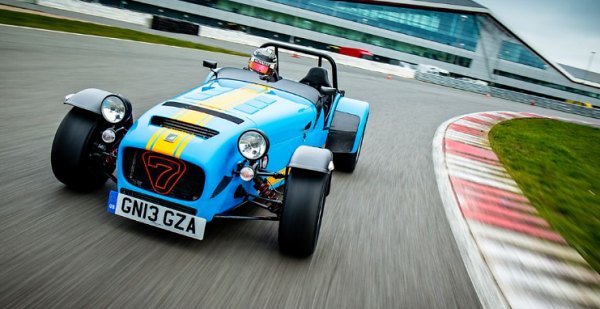
The 620R is not going to rewrite the formulas. In fact, it looks
remarkably close to the last R500, with the chief difference lies on an
additional nose intake. This intake draws more fresh air to cool the
now supercharged engine. Based on the R500’s 2.0-liter Ford Duratec
16V, a centrifugal supercharger is bolted on to boost its output from
263 to 310 horsepower at 7700 rpm. Maximum torque is lifted from 177 to
219 pound-foot, and it arrives at a high 7350 rpm. Such a peaky manner
is no surprise to me, because a centrifugal supercharger delivers its
best at high rev. To a flyweight machine with limited traction, the
linear or even peaky power delivery is actually a good thing, allowing
the driver to manage the power more easily. The 620R tips the scale at
545 kg, which returns a power-to-weight ratio of 569 hp per ton.
Although it doesn’t quite meet the target of 620 hp/ton, it is still
higher than many supercars.
Another important change is the use of a sequential gearbox with 6
forward ratios. Although the gearshift is accompanied with crashy
noises, skipping clutch action makes acceleration so much more seamless
and lightning quick, taking full use of its enormous power-to-weight
ratio. How fast is it then? Caterham claims 0-60 mph is achieved in
2.79 seconds. If you can find a high-grip track and manage the start-up
traction skillfully – there is neither traction control nor launch
control on this classic – you could find it even quicker. Only a
handful of supercars could beat it for up to 100 mph. Even fewer could
dare to race against it around a twisty race track – the tighter the
turns, the more likely the Caterham can excel. Its wide-track
double-wishbone front suspensions and de Dion rear axle might be no
different from the R500, but the new semi-slick Avon ZZR rubbers shod
around the magnesium wheels afford even more grip.
Ultimately, the Caterham is still more difficult to handle than Ariel
Atom. Its front-engined layout means less traction to rely on, and the
old-fashioned rear axle fails to offer optimized grip on bumps. Its
steering is very quick at just 1.93 turns lock-to-lock, but it is also
very hefty. Other controls are equally physical, although they deliver
race-car-like direct feel. Used as a road car, the 620R is a joke.
Lacking any weather protection or even a windscreen, you have to wear a
helmet and have yourself exposed in frenetic wind and noises –
especially that crazy exhaust bark. The suspension is hard for typical
British B-roads. It feels more at home on race tracks. After all, this
is primarily a race car. Making it road-legal just allows you to drive
it straight from home to tracks.
|
Verdict: not
rated
|
|
|
|
|
|
|
|
|
|
|
Seven Superlight R500
|
1999
|
Front-engined,
RWD
|
Tubular steel spaceframe
|
Aluminum, carbon-fiber
|
| 3380 / 1575 / ? mm |
| 2225 mm |
| Inline-4 |
| 1796 cc |
DOHC 16 valves
|
| - |
| - |
230 hp / 8600 rpm
|
155 lbft / 7200 rpm
|
6-speed manual
|
F: strut
R: de Dion axle + Watts link
|
| - |
F: 185/55R13
R: 215/50R13
|
460 kg
|
145 mph (est)
|
3.4*
|
8.1*
|
|
Seven
CSR 260
|
2005
|
Front-engined,
RWD
|
Tubular steel spaceframe
|
Aluminum, carbon-fiber
|
| 3300 / 1685 / 1140 mm |
| 2315 mm |
| Inline-4 |
| 2261 cc |
DOHC 16 valves
|
| - |
| - |
260 hp / 7500 rpm
|
200 lbft / 6200 rpm
|
6-speed manual
|
All: double-wishbones
|
| - |
F: 195/45R15
R: 255/40R15
|
570 kg
|
155 mph (c)
|
3.1 (c) / 3.3*
|
7.6*
|
|
Seven Superlight R500
|
2008
|
Front-engined,
RWD
|
Tubular steel spaceframe
|
Aluminum, carbon-fiber
|
| 3300 / 1575 / 800 mm |
| 2225 mm |
| Inline-4 |
| 1999 cc |
DOHC 16 valves
|
| - |
| - |
263 hp / 8500 rpm
|
177 lbft / 7200 rpm
|
6-speed manual
|
F: double-wishbone
R: de Dion axle + Watts link
|
| - |
F: 175/55R13
R: 205/55R13
|
506 kg
|
150 mph (c)
|
2.9 (c)
|
-
|
|
|
|
|
|
Performance
tested by: *Autocar
|
|
|
|
|
|
|
Seven
620R
|
2013
|
Front-engined,
RWD
|
Tubular steel spaceframe
|
Aluminum, carbon-fiber
|
| 3300 / 1575 / 800 mm |
| 2225 mm |
| Inline-4 |
| 1999 cc |
DOHC 16 valves
|
| Supercharger |
| - |
310 hp / 7700 rpm
|
219 lbft / 7350 rpm
|
6-speed sequential
|
F: double-wishbone
R: de Dion axle + Watts link
|
| - |
F: 185/55R13
R: 215/55R13
|
545 kg
|
155 mph (c)
|
2.8 (c)
|
-
|
|
|
|
|
|
|
|
Performance
tested by: -
|
|
|
|
|
|
|
|
|
Copyright©
1997-2014
by Mark Wan @ AutoZine
|
|